{{ section.name }} Asiakastuki

Löysimme {{ category.count + ' ' + (category.count == 1? category.label:category.pluralLabel) }} ja {{ category.count + ' ' + (category.count == 1? category.label:category.pluralLabel) }} haulle '{{ searchTerm }}'

0 Results found

{{ section.name }} Asiakastuki
Hae matkakohteita, aktiviteetteja, yliopistoja, kokemuksia...

Löysimme {{ category.count + ' ' + (category.count == 1? category.label:category.pluralLabel) }} ja {{ category.count + ' ' + (category.count == 1? category.label:category.pluralLabel) }} haulle '{{ searchTerm }}'

0 Results found

Etkö löytänyt etsimääsi?

Ota yhteyttä, niin autamme sinua eteenpäin matkasuunnitelmissasi.
arunga_kilimanjaro_1
Itinerary

Kilimanjaro - Machame Route - 7 Days on the Mountain

Daily Program

Below is the itinerary for your trekking adventure.

Day 1: Arrival in Kilimanjaro Airport

You arrive in Tanzania, where you will be met and transferred to your hotel in Moshi. The rest of the day is at leisure.

Day 2: Moshi and surroundings on your own

Explore Moshi and on clear days take in the view of Kilimanjaro, your home for the coming days. You should also use the time to prepare your trekking equipment so you are ready to start the trek the following day.

Meals included: Breakfast

Day 3: Moshi - Machame Gate - Machame Camp

You will be picked up from your hotel in Moshi and driven to Machame village, where there will be a short stop. Guides and porters prepare and pack supplies and your equipment for the trek. You will receive a packed lunch and have the opportunity to purchase water in the village. Depending on road conditions, you will be driven to Machame Gate, where today’s trek begins. If the road is muddy, the final 3 km will take about an hour to walk. After arrival at the gate and registration, the trek begins through sub-tropical forest up to Machame Camp at an altitude of 3,000 meters. Lunch is taken en route, with arrival at camp in the late afternoon. Your porters (arriving at the camp site long before you) will have erected your tent on your arrival. In the evening, the porters will boil drinking and washing water and the cook will prepare dinner, before you retire to your tent for the night. Night temperatures can already drop to freezing point at this campsite.

Estimated trekking time: 6-7 hours, 11 km.
Meals included: Breakfast, lunch and dinner

Day 4: Machame Camp - Shira Camp

The day starts with a steady ascent lasting about one hour, after which the climb continues more moderately for the next few hours across heathland until lunch. After lunch, the trek continues along a steep cliff through heath and moorland toward the Shira Plateau, where the route turns west. The goal is Shira Camp at an altitude of 3,840 meters. The night at this exposed camp will even be colder than the previous night, with temperatures dropping to well below freezing,

Estimated trekking time: 5-6 hours, 5 km.
Meals included: Breakfast, lunch and dinner

Day 5: Shira Camp - Barranco Camp via Lava Tower

After breakfast, the trek continues east across rocky desert terrain and glacial streams until reaching Lava Tower at an altitude of 4,600 meters. Many people feel the effects of altitude here for the first time, but this ascent helps the body acclimatize more quickly. After lunch near Lava Tower, the descent begins to Barranco Camp, located at 3,950 meters with views of the impressive Barranco Wall.

Estimated trekking time: 7-8 hours, 10 km.
Meals included: Breakfast, lunch and dinner

Day 6: Barranco Camp - Karanga Valley Camp

After breakfast, start climbing up the steep Baranco wall with some sections of easy scrambling then climb down to Karanga valley camp where you will take a break for lunch. After lunch the group will go for acclimatization climbs towards Barafu camp and then back to Karanga Valley camp for dinner and your overnight stay, located at 4050 metres.

The route on this day with its numerous ascents and descents allow you a chance for further acclimatization.

Estimated trekking time: 3-4 hours, 4.5km.
Meals included: Breakfast, lunch and dinner

Day 7: Karanga Valley camp - Barafu Camp

After breakfast you will begin your way to Barafu camp (4600 m) our last camp before the summit attempt. The landscape transforms into an alpine desert as we navigate the rocky terrain. The campsite offers stunning views of the surrounding peaks and glaciers. Once we have reached the camp, it is advisable to spend the remainder of the day resting in preparation for the summit climb later that night. Dinner and overnight stay at Barafu camp.

Estimated trekking time: 3-4 hours, 4km.
Meals included: Breakfast, lunch and dinner

Day 8: Barafu Camp - Summit attempt to Uhuru Peak - Mweka Camp

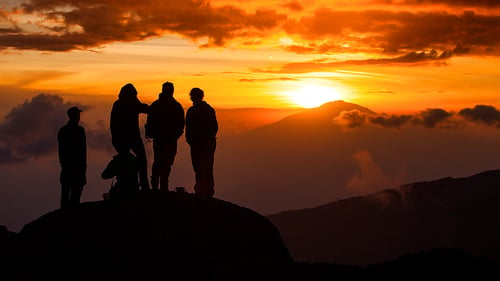
Around midnight, the summit attempt to Uhuru Peak begins - Africa’s highest point at 5,896 meters. You make a short stop at Stella Point at 5,685 meters to enjoy the early sunrise. The final hours of trekking to Uhuru Peak usually take place in snow. After enjoying the magnificent view from the summit, you begin the descent back to Barafu Camp. Here you take a well-deserved rest, have something to eat, and pack the remainder of your gear before continuing down to Mweka Camp, located at 3,100 meters.

Estimated trekking time: approx. 7-8 hours, 5 km to Uhuru Peak, and approx. 6-8 hours, 12 km to Mweka Camp. You will trek approximately 14-16 hours this day.
Meals included: Breakfast, lunch and dinner

Day 9: Mweka Camp - Moshi

On the final day of the trek, you return to Mweka Gate through sub-tropical forest, where you say goodbye to your team and receive your trekking certificate. From the gate, you walk a short distance to Mweka village, where you will be driven back to your hotel in Moshi. Here your fantastic experience on Africa’s highest mountain comes to an end, and you can look forward to a well-deserved hot shower at your hotel.

Estimated trekking time: 3-4 hours, 10 km.
Meals included: Breakfast

Day 10: Moshi - Free time

You have the day at leisure. It is ideal to relax by the hotel pool, explore the streets of Moshi, enjoy the local atmosphere, or join one of the many exciting day trips in the area. It is also possible to go on a one-day safari from Moshi, though this involves considerable driving time. If you have a full day available, it is possible to visit Arusha National Park, Lake Manyara National Park, or Tarangire National Park. If you choose to spend the final full day of the trip on a wildlife-rich safari experience, we recommend staying overnight in Arusha on the last night, as this will reduce driving time back from the national parks. Kilimanjaro International Airport is located midway between the towns of Arusha and Moshi. Let us know if you want to include a safari and we can arrange the changes for you

Meals included: Breakfast

Day 11: Departure from Moshi

The day is at leisure. You will be picked up from your hotel and transferred to Kilimanjaro Airport. The timing depends on your onward flight.

Meals included: Breakfast

Local Payment for group tour

Tipping is mandatory when climbing Kilimanjaro.

The tipping process usually takes place at the end of the trip. At this time, the entire team comes together for a short ceremony, during which diplomas are awarded to those who reach the summit. This is followed by singing, eating, and drinking. After these activities, clients may hand over the tips to the team.

It is recommended to have a combination of 1, 5 and 10 dollar bills of recent date. Please note that 2 dollar and 50 dollar bills cannot be used. The tips are given to the main guide, who after the trekking tour distributes the total amount between local guides, porters and helpers.

After tipping, the team will say goodbye to the clients, and the clients will be transferred to their respective hotels.

NOTE: By law, you are only allowed to bring up to USD 200 per person into Kilimanjaro National Park. Therefore, the above gratuity will be settled at the hotel when you return from the mountain.

Notes

If you are interested in one of the other routes to the top of Kilimanjaro, you are very welcome to contact us for more information.

IMPORTANT: As of June 1, 2019, it has been enacted by law that plastic bags are no longer permitted to be brought into Kenya, Tanzania, and Rwanda.
The authorities enforce this law by carrying out random inspections of travelers’ luggage at airports.
Violation of the law may result in fines - and in particularly serious cases, imprisonment. Please pay close attention to this regulation.
Bring only essential items on the mountain (maximum 15 kg per person).

Please note that porters accompany the trek and carry all equipment and your main backpack. We recommend bringing a small daypack in which you can carry camera equipment, drinking water, snacks, rainwear, a warm fleece, and other essentials you may need during the day.
All necessary trekking equipment can also be rented at the destination. Ask us about prices.

Please be aware that altitude sickness can occur on all treks, even if recommended guidelines are followed. It should also be noted that some treks do not fully comply with recommended guidelines regarding, for example, sleeping altitude, as they would otherwise not be feasible.
All trekking tours are well-tested, and trekkers rarely suffer from altitude sickness. However, it is extremely important that you descend to a lower altitude if you experience symptoms of altitude sickness (such as headache, shortness of breath, or vomiting). Altitude sickness is an acute condition and must be taken very seriously.
You should consult your doctor and discuss possible preventive measures for altitude sickness in relation to your trek.
The trek is not permitted for children under the age of 10.
Please note that participation in trekking is at your own risk, so remember to arrange travel insurance before departure.
Yhteenveto

What’s included?

Accommodation

2 nights pre- and 2 nights post-trek accommodation is at Honey Badger Lodge in either Single, Double or Triple ensuite room.
Honey Badger Lodge is a hidden oasis with breathtaking views of Mount Kilimanjaro and offers 24-hour front desk, wheelchair access, fully licensed bar/lounge, restaurant, outdoor pool, WiFi.

Accommodation while on trek is in tents.

Local transport

Arrival and departure transfers to/from Kilimanjaro Airport and Moshi, as well as transfers to and from the base of the mountain are included.

Meals

Meals according to itinerary.

How is cooking done on the mountain?
We use modern Kerosene stoves. These are very efficient (about 90% of the efficiency of gas, which is not always available here) and reliable. You can also feel satisfied that no firewood is being used which might damage the ecology of the mountain.

What is a typical menu during the trek?
Our trekkers are ever amazed with the quality and quantity of food we supply to them during the climb. Generally, we provide a three course menu for each trekker. Meals are made to high standards and are mainly delicious, sometimes better than those in most luxury hotels noting the circumstances under which these are prepared. All meals are made to international standards. Vegetarian and non-vegetarian meals are provided.

Kilroy.OutdatedBrowserBox.Text Kilroy.OutdatedBrowserBox.LinkText

Hakemasi sivu näyttäisi olevan kadoksissa. Jos et löydä etsimääsi, kysy meiltä apuja sivun alakulmasta.